.webp)

How to Read a Moving Quote: A Complete Guide to Understanding Moving Estimates
Written by:
Superior Moving & Storage
Published:
July 2, 2026
Not sure what's in your moving estimate? Learn how to read a moving quote, spot hidden fees, and compare estimates confidently before you hire a mover.
Understanding your moving quote is one of the most important steps you can take before signing anything with a moving company. Most people receive a quote, glance at the total, and make a decision based on the number alone. That approach works fine when all estimates are structured the same way — but they're not. Two quotes for the same move can look nearly identical on the surface and differ by hundreds of dollars once the job is done, simply because of how certain costs are classified, disclosed, or left out entirely. At Superior Moving & Storage, we believe an informed customer makes better decisions — and a better experience for everyone. This guide walks you through exactly how to read a moving estimate, what every line item means, and what to watch for before you commit.
Reading a moving quote isn't about distrust. Most moving companies are straightforward and transparent. But the moving industry does have a vocabulary — binding estimates, non-binding estimates, accessorial charges, valuation coverage — and if you don't know the terms, you can't ask the right questions. Here's the knowledge you need.
The Three Types of Moving Estimates and What They Mean
Before you compare prices, you need to know what kind of estimate you're looking at. Not all moving quotes carry the same legal weight or the same risk to your wallet.
Non-Binding Estimates
A non-binding estimate is the most common type. It represents the moving company's best projection of what your move will cost based on the information provided — typically the volume of belongings, distance, and services requested. The final bill, however, is based on actual weight (for interstate moves) or actual time and labor (for local moves). If your move turns out to weigh more or take longer than estimated, the final cost will be higher. Federal regulations for interstate moves do limit how much above the estimate a carrier can demand at delivery, but the final number can still surprise you if the estimate wasn't thorough.
Non-binding estimates are legitimate and common. The risk comes when they're based on incomplete information — when you didn't show the estimator everything being moved, or when specialty items weren't disclosed upfront.
Binding Estimates
A binding estimate is a fixed price. The moving company agrees to move your described inventory for the quoted amount, regardless of the actual weight or time it takes. If the job runs over, that's the company's problem. If it runs under, you pay the agreed price. Binding estimates offer predictability, which many customers prefer — but they come with an important caveat: they're only as accurate as the inventory that was assessed. If you add items on moving day that weren't included in the original estimate, the company is entitled to revise the price.
Binding Not-to-Exceed Estimates
This is the most customer-friendly structure. Like a binding estimate, it fixes the maximum you'll pay. Unlike a standard binding estimate, if the actual weight or time comes in lower than projected, you pay the lower amount. Not all companies offer this type, but it's worth asking about — particularly for larger interstate moves where weight can fluctuate.
Breaking Down the Line Items in a Moving Quote
Once you know what type of estimate you have, the next step is understanding what's inside it. A well-structured moving quote should clearly itemize costs rather than presenting a single lump sum. Here's what to look for and what each line should mean.
Base Rate or Transportation Charge
This is the core cost of the move — the charge for the truck, the crew, and the labor involved in loading, transporting, and unloading your belongings. For local moves, this is usually expressed as an hourly rate multiplied by estimated hours. For long-distance moves, it's typically based on weight and mileage. Either way, this should be the largest single number on the quote and clearly labeled.
Fuel Surcharge
Many companies add a fuel surcharge on top of the base rate. This is standard practice and not inherently a red flag — fuel is a real cost. What you want to confirm is whether the fuel surcharge is a flat fee or a percentage, and whether it's already included in the quoted rate or added afterward. Ask specifically: "Is the fuel surcharge included in this total, or will it appear on the final invoice?"
Packing and Materials
If you're using professional packing services, the cost of packing labor and materials should appear as a separate line item. This is one of the most common areas where quotes diverge significantly. Full packing (the company packs everything), partial packing (they pack fragiles or a specific room), and materials-only charges (boxes, tape, paper, bubble wrap) all carry different costs. Make sure the quote specifies which service is included and that it matches what you actually requested.
Specialty Item Charges
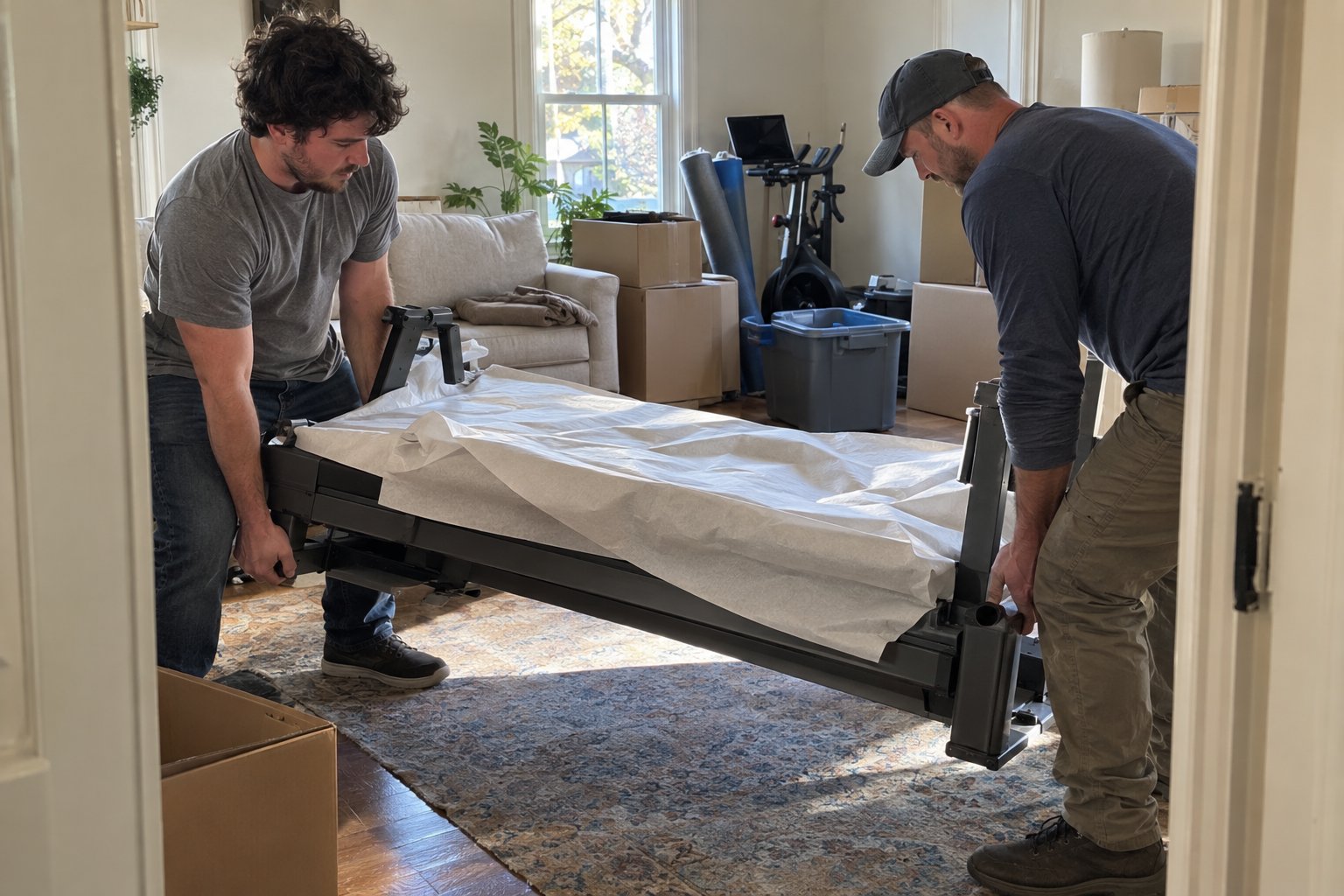
Pianos, gun safes, pool tables, large artwork, exercise equipment, and other items that require special handling, additional crew members, or specialized equipment are typically priced separately. If you have any items that fall into this category, they should appear on the quote explicitly. If they don't — and you know you have them — ask before signing. Discovering a specialty item surcharge on moving day is one of the most common sources of billing surprises. Learn more about how professional movers handle these situations through specialty moving services.
Accessorial Charges
Accessorial charges are fees for services beyond the standard load-and-unload. Common examples include:
- Long carry: A charge when movers must carry items an unusually long distance from the truck to the door (common in urban areas with limited parking or gated communities).
- Stair carry: An additional fee per flight of stairs beyond the first, particularly relevant for multi-story walkups.
- Elevator fee: Sometimes charged when a freight elevator isn't available and a passenger elevator must be used, adding time.
- Shuttle service: If the destination isn't accessible to a full-size moving truck, your belongings may need to be transferred to a smaller vehicle. This adds both time and cost.
- Storage-in-transit: If your new home isn't ready and items need to be held temporarily, storage charges will apply.
Not every move incurs accessorial charges. But every quote should either include them (if applicable) or explicitly state that they may apply under specific conditions. The worst outcome is a quote that doesn't mention them at all, leaving you without a frame of reference if they appear on the final invoice.
Valuation Coverage: What Your Quote Tells You About Protection
Every moving quote should include a section on valuation — and this is one of the most misunderstood parts of any moving estimate. Valuation is not the same as insurance. It's the level of liability the mover accepts if your belongings are damaged or lost.
Released Value Protection (Basic)
This is the default coverage included at no charge. For interstate moves, it's set by federal regulation at 60 cents per pound per item. On a local move, the calculation may differ. What this means in practice: if a 50-pound flat-screen television is damaged, the mover's maximum liability is $30 — regardless of what the TV cost. This coverage is free because it's minimal. Most customers don't realize this is all they have unless they ask.
Full Value Protection
Full value protection is the higher tier. Under this arrangement, if an item is lost, destroyed, or damaged, the mover must either repair it, replace it with a like item, or provide a cash settlement at current market value. This coverage costs extra and will appear as a line item on your quote if you've requested it. The exact cost varies by company and by the declared value of your shipment. If you're moving high-value items, this coverage is almost always worth the cost.
Third-party moving insurance is also available through separate insurers and may be worth exploring for high-value moves or long-distance relocations.
Red Flags in a Moving Quote
Most moving quotes are honest representations of what a company expects to charge. But there are patterns worth watching for — not because every company that does them is disreputable, but because they can lead to billing surprises.
Unusually Low Estimates
If one quote is dramatically lower than several others for the same move, that warrants a question rather than immediate acceptance. A low estimate can reflect an efficient company — or it can reflect an incomplete estimate that doesn't account for all the services your move actually requires. Ask what the estimate is based on, what's not included, and what situations would cause the final bill to increase.
Large Upfront Deposits
Reputable moving companies typically require a modest deposit or no deposit at all for local moves, with payment due at delivery. A company demanding a large deposit — particularly in cash — before any work is done is a meaningful warning sign. This is a documented pattern in moving fraud.
Vague Line Items or a Single Lump Sum
A quote that just says "moving services: $X" with no breakdown makes it impossible to verify what's included or to compare accurately against other estimates. Ask for itemization before signing anything.
Missing Inventory Assessment
A responsible estimate requires some form of inventory — either an in-home walkthrough or a detailed virtual survey of what's being moved. If a company quotes you a number without asking about your belongings in meaningful detail, the estimate isn't accurate. It's a placeholder.
How to Compare Multiple Moving Quotes Accurately
Once you have two or three estimates in hand, comparison requires more than looking at the totals. Here's a framework for making an accurate side-by-side evaluation.
- Confirm the estimate type. Binding and non-binding quotes can't be directly compared. Standardize by asking every company for the same type, or factor in the risk differential consciously.
- Check whether all services are included. Packing, specialty items, and accessorial charges may be in one quote and absent from another. Add them back in for comparison.
- Verify valuation coverage levels. One quote may include full value protection while another defaults to released value. The difference in coverage is significant.
- Confirm what's triggering any variable costs. For hourly local quotes, ask what the minimum charge is, whether there's a travel fee, and how overtime is handled.
- Read the cancellation and rescheduling policy. If your closing date shifts or circumstances change, you want to know the financial consequences before you're in that situation.
If two quotes are genuinely equivalent in coverage and service, then price becomes the deciding factor. If they're not equivalent, price alone is a misleading comparison.
Questions to Ask Your Moving Company Before Signing
No matter how clearly a quote is written, a brief conversation before signing resolves most ambiguity. These are the questions worth asking every company:
- Is this a binding or non-binding estimate? If non-binding, what circumstances are most likely to change the final price?
- Are there any services I requested that are not included in this quote?
- Are there any conditions at my origin or destination — parking, stairs, elevator, distance from truck — that could trigger additional charges?
- What valuation coverage is included, and what does it cost to upgrade?
- What is your cancellation policy, and what happens if my move date changes?
- Who will be performing the move — your employees, or subcontractors?
A company that answers these questions clearly and without defensiveness is signaling the kind of transparency that characterizes a trustworthy mover. A company that hedges, deflects, or pressures you to sign before discussing them is telling you something important.
Understanding a moving quote isn't complicated once you know the vocabulary. The customers who get the fewest surprises on moving day are the ones who took twenty minutes to read the estimate carefully, ask a few questions, and confirm that what they were quoted reflects what they actually need. That preparation is one of the most valuable things you can do before your move begins.
Frequently Asked Questions
What is the difference between a binding and non-binding moving estimate?
A binding estimate is a fixed price — the mover agrees to complete your move for the quoted amount regardless of actual weight or time. A non-binding estimate is a projection; the final bill is based on actual weight (for long-distance moves) or actual hours (for local moves) and can differ from the quote. Binding estimates offer price certainty, while non-binding estimates carry some variability — especially if your inventory changes between the estimate and moving day.
Why did my final moving bill come out higher than my quote?
The most common reasons a final moving bill exceeds the original quote are: undisclosed items that weren't included in the original inventory, accessorial charges (like long carries, stair fees, or shuttle service) that weren't anticipated, packing materials or services that were added on moving day, or a non-binding estimate where actual weight exceeded the projection. Reviewing your quote itemization and comparing it line-by-line against the final invoice will show you exactly where the difference occurred.
What are accessorial charges on a moving quote?
Accessorial charges are fees for services beyond the standard load, transport, and unload. Common examples include long carry fees (when movers must walk items an unusually long distance from the truck), stair carry fees (extra charge per flight of stairs), elevator fees, shuttle service fees (when the destination isn't accessible to a full-size truck), and storage-in-transit charges. These should be disclosed in your quote if they're likely to apply — always ask your mover to confirm which, if any, are anticipated for your specific move.
What does valuation coverage mean on a moving estimate, and is it the same as insurance?
Valuation coverage is the level of liability your mover accepts if your belongings are lost or damaged — it is not the same as traditional insurance. The default (Released Value Protection) is free but minimal, providing only 60 cents per pound per item for interstate moves. Full Value Protection is an upgrade that requires the mover to repair, replace, or compensate for damaged items at current market value. For high-value moves, it's worth requesting Full Value Protection or exploring third-party moving insurance.
What should I do if I receive a moving quote that seems unusually low?
A significantly lower-than-average quote warrants careful scrutiny before acceptance. Ask the company what the estimate is based on, what services are and aren't included, and what circumstances would cause the final bill to increase. Verify that the company is licensed and insured, and check their reviews and complaint history. A low estimate can reflect a genuinely efficient operation — or it can reflect an incomplete assessment or, in rare cases, a fraudulent operation that inflates charges after your belongings are loaded. Comparing itemized quotes side-by-side (not just totals) is the most reliable way to evaluate.




Have Questions About Your Move?
Find clear answers to common moving questions. Learn more about our services, process, and what to expect on moving day.
Our team is here to help. Contact us for personalized assistance with your moving needs.
Ready for a Stress-Free Move?
Let our family help your family with a move handled the right way from start to finish. Request your free quote today and see why Philadelphia families have trusted us since 1981.