
Can You Move a Chest Freezer Without Defrosting It First?
Written by:
Superior Moving & Storage
Published:
November 9, 2026
Can you move a chest freezer without defrosting it? Find out when it's safe to skip the defrost and when waiting is the better move.
Can you move a chest freezer without defrosting it? For a short trip across town, yes, as long as it's been off long enough to stop actively cooling and you're prepared for condensation and extra weight. For anything longer than a quick local move, or if the freezer is more than about a quarter full, defrosting first is almost always the safer call. The right answer depends less on the calendar and more on distance, how full the freezer is, and how it will be laid down (or not) during transport.
When Is It Safe to Skip Defrosting a Chest Freezer Before a Move?
Skipping the defrost works best when the move is short, the freezer stays upright the entire time, and it isn't packed solid with food. A nearly-empty chest freezer with a light layer of frost can usually travel upright in an enclosed truck for a local move without major issues, since there's little ice mass to melt and shift around.
If you're relocating within the area and the freezer will be loaded last and unloaded first, keeping it running until moving day and then unplugging it a few hours ahead can work. The key conditions:
- The freezer stays upright. Chest freezers have a sealed compressor and refrigerant lines that depend on orientation. Tipping one on its back or side, even briefly, can let oil migrate into the lines.
- The trip is short. A few hours between unplugging and plugging back in gives frost a chance to stay mostly frozen without turning into standing water inside the cabinet.
- It's not stuffed with food. A full freezer is heavier, harder to carry safely, and more likely to leak once ice starts to soften.
What Happens If You Don't Defrost a Chest Freezer Before Moving?
Without defrosting, you're moving extra weight in ice, risking water damage to the truck and your other boxes, and increasing the odds of compressor strain when it's plugged back in. None of these are guaranteed problems, but they stack the deck against you on anything other than a short, careful move.
Built-up frost and ice inside a chest freezer can weigh as much as the food itself. That extra weight makes the unit harder to lift safely and shifts the load unpredictably if the truck brakes hard or takes a turn. As frost melts in transit, water pools at the bottom of the cabinet and can leak out through the door seal, soaking anything packed nearby. And a freezer that's moved while still cold, then immediately plugged back in, may run the compressor harder than normal as it recalibrates to its surroundings.
Why Orientation Matters More Than Temperature
Most of the real risk with chest freezers has nothing to do with frost at all. It's about keeping the unit upright. Compressors use oil that lubricates internal components, and that oil settles based on gravity. Laying a chest freezer on its side, even for a short ramp incline, can let oil pool somewhere it shouldn't. If the freezer must be tilted briefly to clear a doorway, keep it as close to vertical as possible and let it sit upright for several hours before plugging it in again.
How Should You Prepare a Chest Freezer for a Move If You Do Defrost It?
If you've decided to defrost, start by emptying and unplugging the freezer at least a day before moving day so the ice has time to melt completely. Prop the lid open, line the bottom with old towels, and let gravity do the work rather than chipping at ice with a hard tool.
Once it's fully defrosted and dry:
- Wipe down the interior with a mild cleaning solution to prevent odors from developing in a sealed, powered-off unit during transit.
- Leave the lid propped slightly open with a rolled towel so air can circulate and moisture doesn't get trapped.
- Secure any loose shelving or baskets inside so they don't rattle or scratch the interior during the drive.
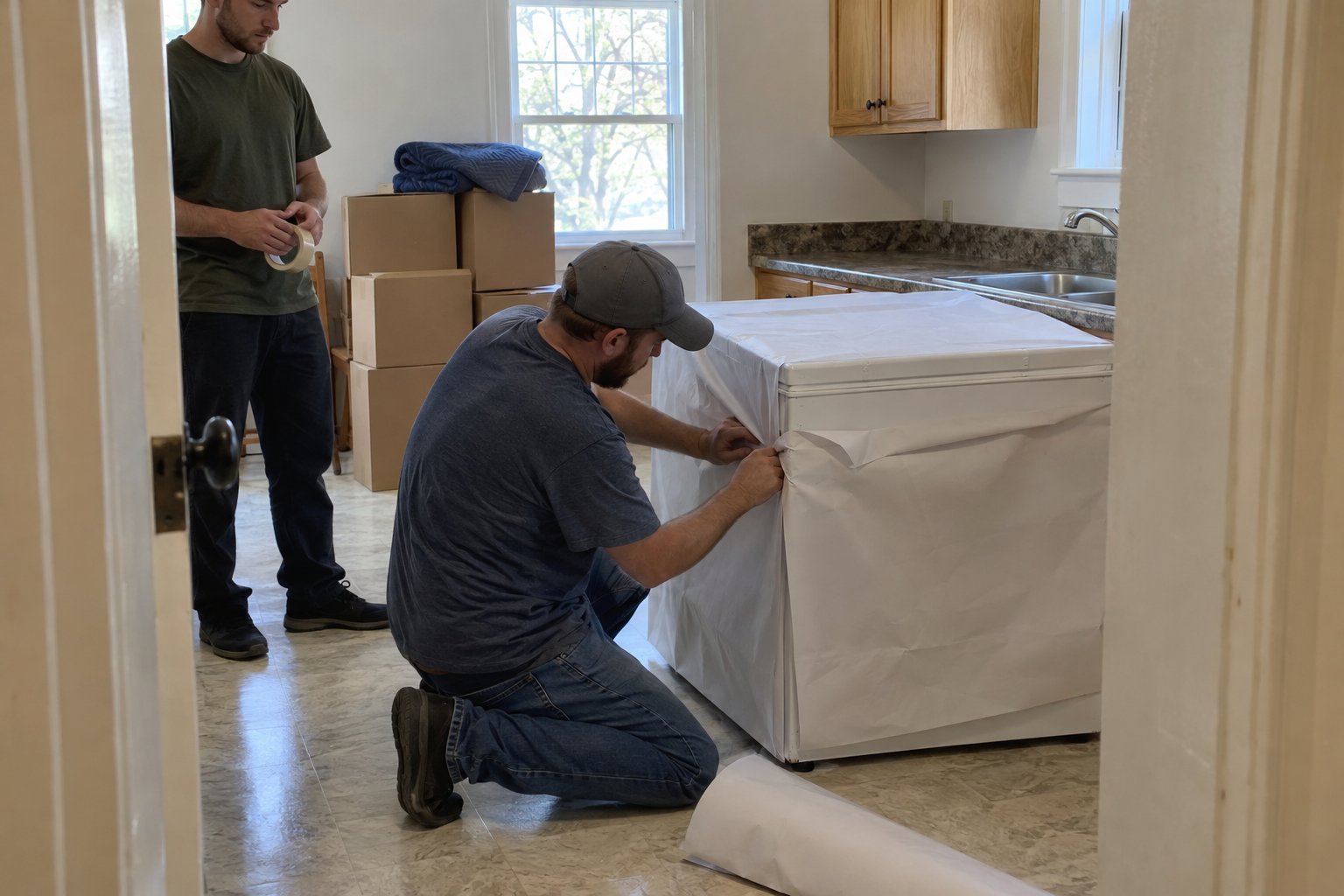
- Wrap the exterior in moving pads or blankets, particularly around the corners and the compressor housing on the back.
A defrosted, dry, empty freezer is dramatically easier and safer to carry than a full one, and it removes the water-damage risk entirely. Our crews can carry and load heavy appliances like these as part of a move, and if your floors or stairs are a concern on the way out, ask about hoisting services for anything that won't fit through a standard doorway or stairwell.
Should You Defrost a Chest Freezer for a Long Distance Move?
Yes. For anything beyond a same-day local move, defrosting isn't optional advice, it's the practical baseline. A freezer that sits loaded on a truck for an overnight haul or a multi-day long distance move has far more time for ice to melt into standing water, and far more opportunity for temperature swings to stress the compressor.
If your move is local and scheduled so the freezer spends only an hour or two off its power source, skipping the defrost is a reasonable shortcut. If there's any uncertainty about timing, a delay at the new place, or a longer drive, defrost it. It's a few extra hours of prep against a much larger cleanup or repair if something goes wrong in transit.
What to Do With the Food Inside
Plan for the food separately from the appliance. A cooler packed with ice packs can hold frozen food for the length of a local move, but for longer moves, plan to use up, give away, or otherwise part with perishables rather than trying to keep them frozen for an extended drive without dedicated refrigeration.
Planning your move? Request a quote from Superior Moving & Storage.
Frequently Asked Questions
How long before moving day should I unplug a chest freezer?
If you're defrosting it, unplug and empty it at least a day ahead so all the ice has time to melt and the interior can dry. If you're not defrosting because the move is short, unplugging it a few hours before loading is usually enough.
Can a chest freezer be laid on its side to fit through a doorway?
It's best avoided. If there's no other way to clear a tight space, keep the tilt as brief and close to vertical as possible, then let the freezer sit upright for several hours before plugging it back in.
Will food stay frozen during a local move if I don't defrost the freezer?
For a short trip with the lid kept closed, food typically stays cold enough for the duration, but it isn't a guarantee. Packing perishables in a cooler with ice packs as a backup is a good habit regardless.
How long should a chest freezer sit before being plugged back in?
Give it a few hours upright in its new spot before powering it on, especially if it was tilted at all during the move. This lets any compressor oil settle back into place.
Do movers need to know a chest freezer is being moved full or empty?
Yes, tell the crew ahead of time whether it still has food and ice inside. That changes how much it weighs, how it should be carried, and how much care it needs around doorways and stairs.




Have Questions About Your Move?
Find clear answers to common moving questions. Learn more about our services, process, and what to expect on moving day.
Our team is here to help. Contact us for personalized assistance with your moving needs.
Ready for a Stress-Free Move?
Let our family help your family with a move handled the right way from start to finish. Request your free quote today and see why Philadelphia families have trusted us since 1981.