
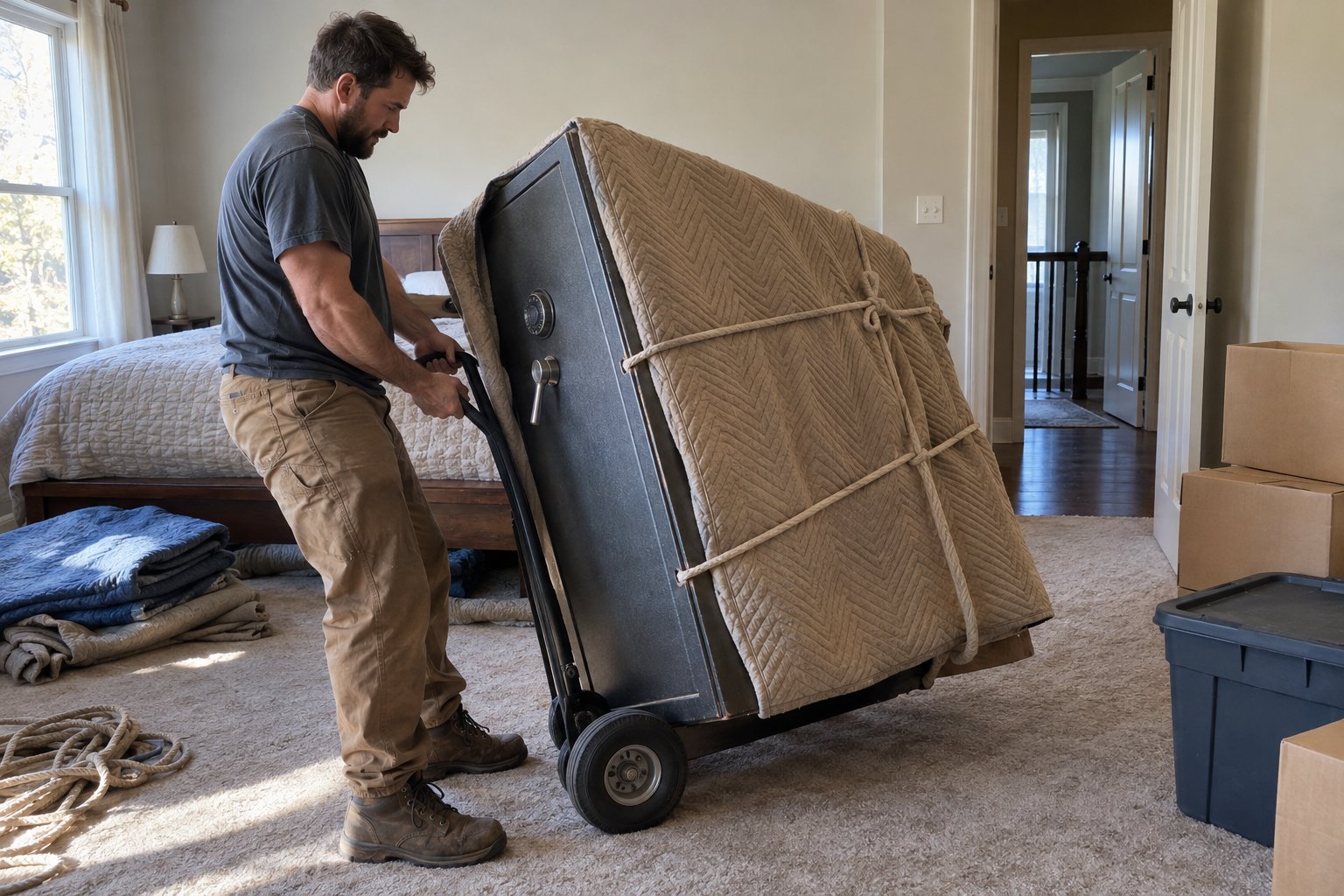
How to Move a Gun Safe by Yourself (And When to Call for Help)
Written by:
Superior Moving & Storage
Published:
October 19, 2026
Learn how to move a gun safe by yourself with the right tools, technique, and safety steps, plus how to tell when the job calls for professional muscle.
Moving a gun safe by yourself is possible for smaller models if you have the right equipment, a clear path, and realistic expectations about your own limits. Most gun safes weigh anywhere from 300 to over 1,000 pounds, which means the wrong move isn't just inconvenient, it can injure you or wreck your floors. This guide walks through how to do it safely when you're working without a crew, and how to recognize the point where a solo move stops being worth the risk.
What Do You Need Before You Try to Move a Gun Safe Alone?
You need a heavy-duty appliance dolly rated for at least your safe's weight, ratchet straps, furniture sliders, a solid ramp if there's a step or threshold involved, and a second person even if you plan to do most of the work yourself. Skipping any one of these is how safes end up tipped over or lodged in a doorway.
Empty the safe completely first. Ammunition, documents, and valuables should travel separately in your vehicle, not inside the safe while it's being tipped and rolled. An empty safe is still extremely heavy, but removing even 50 to 100 pounds of contents makes a meaningful difference when you're muscling it onto a dolly. Measure every doorway, hallway turn, and stairwell along your route before moving day. A safe that's an inch too wide for a hallway corner is a problem you want to discover with a tape measure, not halfway through the move. If you're also trying to protect floors and walls at the same time, lay down runners and corner guards before the safe ever leaves its spot.
How Do You Actually Move the Safe Without Tipping It?
The safest method is to tilt the safe back slightly, slide the dolly's lip underneath it, strap it securely, and keep the center of gravity as low and controlled as possible at every step. Never try to walk a safe across a room on its own feet; that's how ankles and hardwood floors both get crushed.
Start by tilting the safe back just enough to slide furniture blankets or sliders underneath one edge. Work the dolly's base under the safe from the back, then strap it tightly across the body, not just the door, since the door is the heaviest and most unbalanced part. Keep the load as vertical as the dolly allows. A safe tilted too far forward on a dolly can pitch forward unexpectedly, especially on an uneven floor or a slight incline. Move slowly, communicate constantly with your helper, and never let go to adjust your grip. If the dolly starts to tip, let the safe go to the ground in a controlled direction rather than trying to catch it. The same slow, deliberate approach applies to any oversized furniture or cabinetry you're moving that day; rushing a heavy, awkward piece is where most home damage happens.
How to Move a Gun Safe Down Stairs Without Losing Control
Stairs are where solo and two-person safe moves go wrong most often, so the short answer is: don't attempt stairs without a stair-rated dolly, a second person below the safe, and a plan for every single step, not just the general direction. Gravity does the opposite of what you want on a descent, and a safe that gets away from you on stairs can cause serious injury.
Use a stair-climbing hand truck designed for heavy loads, and position the stronger person at the bottom, bearing most of the weight on the way down, while the person at the top controls the pace. Take one step at a time, pause between each, and never let the safe gain momentum. If your stairwell has a landing or a turn, treat that as a separate, deliberate phase of the move rather than part of a continuous slide. A tow strap looped around a banister or stair rail (if it's sturdy enough) can act as a manual winch to control descent speed, but test the anchor point's strength before trusting your safe to it. If your gut says the stairwell is too narrow, too steep, or too twisty for the safe's dimensions, that's usually correct.
When Should You Stop and Call for Help Instead?
Consider calling for professional help any time the safe exceeds roughly 600 to 700 pounds, the route involves stairs with tight turns, or you don't have a second person who can commit to the entire move. A gun safe that's too heavy to control isn't a problem more effort solves; it's a problem more equipment and trained hands solve.
Signs you're past the DIY threshold include a safe that barely fits the stated weight capacity of your dolly, a path that requires lifting the safe over a step rather than rolling it, or a stairwell where two people can't both maintain solid footing. These aren't situations to push through on willpower. Oversized, dense loads that need to travel through tight stairwells or over a railing are exactly the kind of challenge hoisting services are designed to solve, since that equipment lifts and lowers items from the outside of a building rather than forcing a crew to carry the full weight by hand through a cramped interior path. If your move involves more than just the safe, it's worth reading up on moving heavy appliances without wrecking your floors before you commit to a fully DIY day, since many of the same bracing and route-planning principles apply.
Is It Cheaper to Move a Gun Safe Yourself Than Hire Help?
It can save money up front, but factor in the real costs: dolly or equipment rental, potential floor and wall repairs, and the value of your own time and safety. A solo move that goes wrong can cost far more in medical bills or home repairs than hiring help would have in the first place.
If you're already planning a full move and weighing whether to handle heavy, awkward pieces yourself or bring in help for the rest of the house, it's worth comparing that against what a local moving company would charge to handle the job. Request a written moving quote so you can compare real numbers instead of guessing, and ask directly whether a mover's crew and equipment are suited to a load as heavy and unbalanced as a safe before you book.
Gun Safe Moving Checklist
- Empty the safe completely and transport contents separately
- Measure doorways, hallways, and stairwells against the safe's dimensions
- Use a heavy-duty, properly rated appliance dolly and straps
- Recruit at least one capable helper, more for stairs or long carries
- Plan your exact route and clear it of rugs, cords, and furniture
- Move slowly and pause at every direction change or step
- Know your stopping point: call for help if the weight or path exceeds what two people can safely control
Frequently Asked Questions
How many people does it take to move a gun safe?
Most gun safes need at least two people, and heavier models (over 500 pounds) often need three or four, plus proper equipment like a stair-rated dolly. A single person can sometimes manage very small safes under 200 pounds, but even then a second set of hands for stability is strongly recommended.
Can you lay a gun safe on its back to move it?
Most manufacturers advise against laying a gun safe flat, since it can stress the hinges, damage the locking mechanism, or shift internal components out of alignment. If you must tilt it, keep the angle as slight as possible and avoid a full horizontal lay unless the manufacturer specifically allows it.
What's the best dolly for moving a heavy gun safe?
A heavy-duty appliance dolly with a weight rating that comfortably exceeds your safe's weight, plus a stair-climbing attachment if your move involves steps, is the standard choice. Look for a model with a wide base and secure ratchet straps rather than a basic hand truck.
Will moving a gun safe damage my floors?
It can, especially on hardwood or tile, if the safe is dragged instead of rolled on a properly loaded dolly. Using furniture sliders under the dolly wheels and laying down protective runners along your route reduces the risk significantly.
Is it safe to move a gun safe down stairs by yourself with no help?
No, moving a gun safe down stairs alone is not recommended under any circumstances. The combination of weight, an uneven center of gravity, and the risk of losing control on steps makes this one of the few moving tasks where a solo attempt is genuinely dangerous.

Have Questions About Your Move?
Find clear answers to common moving questions. Learn more about our services, process, and what to expect on moving day.
Our team is here to help. Contact us for personalized assistance with your moving needs.
Ready for a Stress-Free Move?
Let our family help your family with a move handled the right way from start to finish. Request your free quote today and see why Philadelphia families have trusted us since 1981.