.webp)
How to Move a Fish Tank Without Killing Your Fish or Cracking the Glass
Written by:
Superior Moving & Storage
Published:
October 12, 2026
Moving a fish tank takes more than draining it. Learn how to transport your aquarium, fish, and gravel safely without stress, leaks, or dead fish.
A fish tank is one of the few things in a house that is alive, fragile, and full of water all at once, which is exactly why it gets left until the last minute on moving day and then causes a crisis. Knowing how to move a fish tank means treating three separate problems as three separate problems: the glass, the water chemistry, and the fish themselves. Rush any one of them and you risk a cracked tank, a stressed or dead fish population, or a bacterial crash that takes weeks to recover from.
This guide walks through what to do in the days before the move, how to handle the tank and its ecosystem on moving day, and what to do the moment you arrive, so the aquarium is one less thing you are improvising at 6pm with boxes everywhere.
Can You Move a Fish Tank With Water Still In It?
No, not for anything beyond a few feet across the same room. Water is heavy, it shifts with every turn and stop, and most tanks (especially anything over 10 gallons) are not built to flex under that kind of sideways pressure while full. Even a short car ride with water inside risks a seam failure or a cracked bottom panel.
The only exception is an extremely short, slow move within the same house, like sliding a 5-gallon tank a few feet to make room for furniture. Anything involving stairs, a vehicle, or a trip of more than a couple of minutes means draining the tank first. If your move also includes other large glass or specialty pieces, it helps to plan the whole load around fragile items rather than treating the aquarium as a one-off problem; our specialty moving services team is used to building a truck layout around exactly this kind of item.
How Do You Move Fish to a New House Safely?
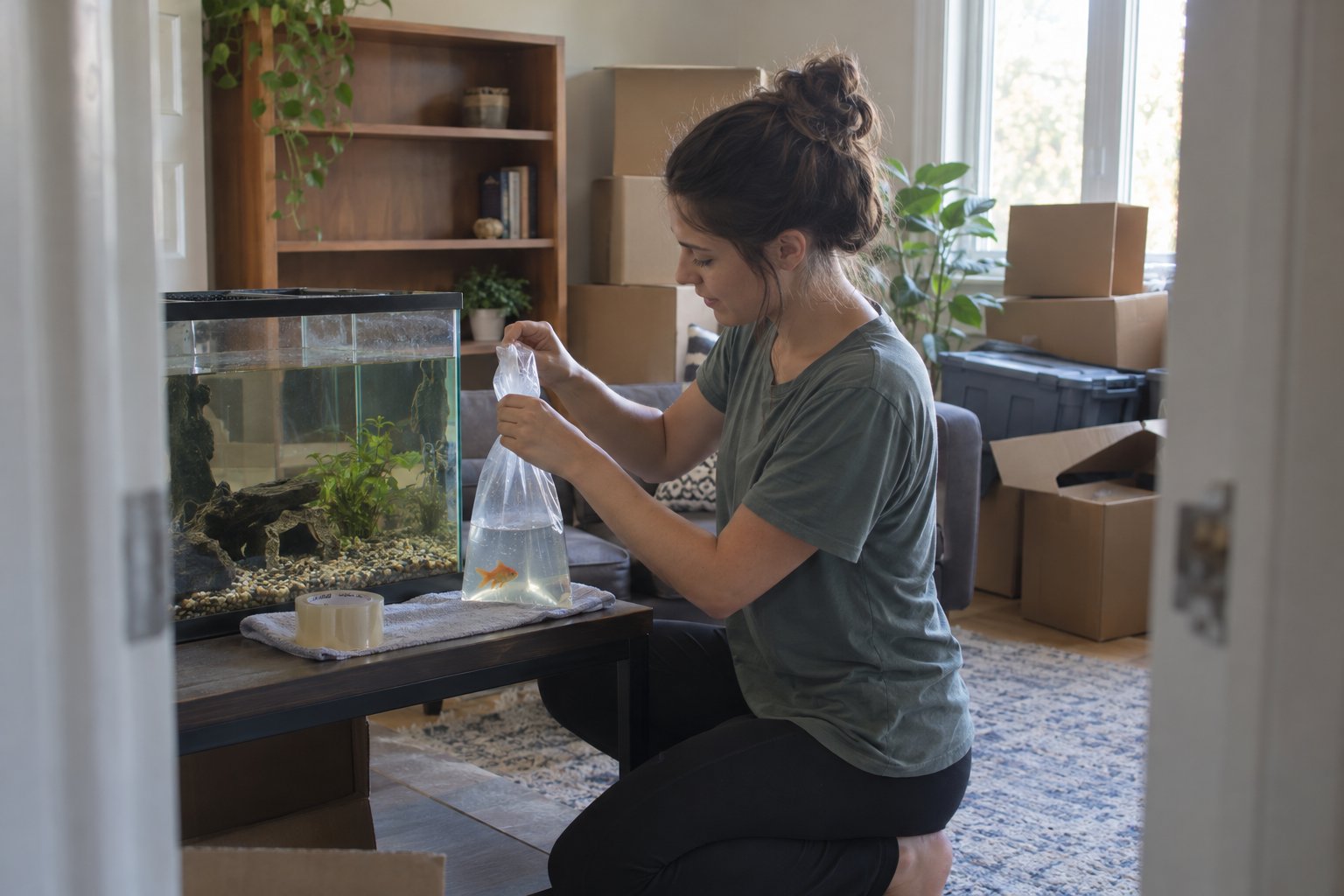
Fish travel best in individual, sealed containers with a mix of old tank water and fresh air space, kept dark and at a stable temperature. The goal is to minimize jostling, temperature swings, and light exposure, all of which spike stress hormones in fish and can trigger illness even if the fish survives the trip itself.
Use heavy-duty plastic bags (the kind pet stores use for fish transport) filled about one-third with tank water and the rest with air, sealed tightly with rubber bands, then placed inside an insulated cooler or box so they cannot tip over. For larger or aggressive fish, a sealed bucket with a lid works better than a bag. Keep the container somewhere temperature-stable in the car, never in a trunk or anywhere that gets direct sun, and never in the moving truck with the rest of the household goods. If the drive is longer than a few hours, float the sealed bags in a few inches of fresh water at your destination for 15 to 20 minutes before release so the fish can adjust to any temperature difference gradually.
For long-distance or multi-day moves, most aquarium owners are better off researching an aquatic transport service or having a friend drive the fish separately on a condensed timeline, since fish simply cannot survive multiple days bagged in stagnant water. If you are coordinating pets of any kind around a long-distance relocation, it is worth reading up on moving your pets safely alongside the fish, since travel timing and vehicle conditions overlap for both.
How Do You Pack Aquarium Water, Gravel, and Décor?
Save as much of the original tank water as you can, since it carries the beneficial bacteria your fish's ecosystem depends on, and pack gravel and decorations damp rather than rinsed clean. Starting over with all-new water and sterile gravel forces the tank to rebuild its nitrogen cycle from scratch, which is hard on fish even if they survive the ride.
Siphon the old tank water into clean, food-grade buckets with tight lids, label them, and keep them out of direct sunlight. Scoop gravel and substrate into sealable bags or buckets while still wet, keeping it submerged in a little tank water if possible rather than letting it dry out. Wrap rocks, driftwood, and artificial plants in towels or packing paper, since these often hide beneficial bacteria too and benefit from staying damp. Filter media (sponges, cartridges, bio-balls) should go into a sealed bag with a little tank water rather than being washed or left to dry, or you lose the bacterial colony that keeps ammonia levels safe.
What's the Safest Way to Transport the Empty Tank Itself?
An empty glass or acrylic tank should be wrapped, cushioned on all sides, and transported flat on a stable surface, never on its side or upside down, and never stacked under other items. Empty tanks are more fragile than full ones in some ways: there is no water to absorb vibration, so every bump in the road transfers straight to the seams and corners.
Wrap the tank in moving blankets or thick padding, with extra cushioning at the corners where glass is most likely to chip. Keep it upright, braced so it cannot slide, and give it its own dedicated space in the vehicle rather than letting other boxes rest against the glass. If the tank is large (55 gallons or more), it is worth asking your moving crew how they prefer to secure oversized glass, since tank stands and canopies often need to travel separately and get reassembled on-site. If you are moving other delicate fixtures in the same load, our guide to packing fragile items for a move covers the cushioning principles that also apply to aquarium glass.
How Do You Set the Tank Back Up Without Shocking the Fish?
Reassemble the tank in its final location first, let it sit until it reaches room temperature, then reintroduce water, gravel, and décor in roughly the order you removed them before adding fish last. Rushing this step, especially adding fish to water that has not stabilized in temperature and chemistry, is when most post-move fish losses happen.
Set the tank on a level, stable surface and check it isn't rocking before adding anything. Pour in the saved tank water first, then add the gravel and décor, then run the filter for at least 30 to 60 minutes before testing the water with a basic aquarium test kit. Match temperature and pH as closely as possible to what the fish are currently bagged in before releasing them, using the slow-float method described earlier. Keep the lights off and monitor the fish closely for the first 24 to 48 hours, since aquariums that have just moved are more prone to ammonia spikes as the bacterial colony reestablishes itself.
Should You Just Leave This to the Movers?
For a small tank with a few hardy fish, most people can manage this themselves with some planning. For a large, heavily stocked, or sensitive tank, especially alongside everything else that needs attention on moving day, it is worth having your moving company flag the aquarium as a fragile, separately handled item rather than letting it get loaded last and unloaded first by accident. If you are already hiring help for other awkward, heavy pieces, it is worth reviewing our guide on moving large, heavy furniture without damage, since the same crew coordination applies to an aquarium stand and canopy.
When you request a moving quote, mention the tank size and that it needs to travel upright and undisturbed. A crew that knows in advance will plan the truck layout and timing around it instead of treating it as an afterthought.
Frequently Asked Questions
How long can fish survive bagged during a move?
Most hardy freshwater fish can tolerate a sealed bag for several hours, generally up to about 8-9 hours, if the water stays cool, dark, and undisturbed. Beyond that, oxygen depletion and ammonia buildup become real risks, so moves longer than a day typically call for a dedicated aquatic transport service rather than a standard bag-and-cooler setup.
Do I need to empty the tank completely before moving it?
Yes, for any move involving a vehicle or stairs. Even partially filled tanks shift weight unpredictably and put stress on the seams, so drain it down to damp gravel and a few inches of saved water in buckets rather than leaving any standing water inside the tank itself.
Will my fish tank's beneficial bacteria survive the move?
It can, if you keep the filter media, gravel, and some original tank water damp and out of direct sunlight rather than rinsing or drying everything. Beneficial bacteria die off quickly without moisture and oxygen, so the faster you reassemble the tank on the other end, the better the colony's odds.
Can I use new water instead of saving the old tank water?
You can, but it means your tank effectively restarts its nitrogen cycle, which is hard on existing fish and raises the risk of an ammonia spike in the first week. Saving as much original water as practical, even just a portion, gives the tank a head start.
What size aquarium is too big to move yourself?
There is no strict cutoff, but tanks over 55 gallons get heavy, awkward, and genuinely dangerous to carry once drained, especially with stairs or tight doorways involved. At that size, most owners find it safer to have moving help handle the tank, stand, and canopy as a coordinated unit.
Have Questions About Your Move?
Find clear answers to common moving questions. Learn more about our services, process, and what to expect on moving day.
Our team is here to help. Contact us for personalized assistance with your moving needs.
Ready for a Stress-Free Move?
Let our family help your family with a move handled the right way from start to finish. Request your free quote today and see why Philadelphia families have trusted us since 1981.