.webp)
How to Move Heavy Appliances When Your Movers Also Offer Hoisting Services
Written by:
Superior Moving & Storage
Published:
August 27, 2026
Wondering if your fridge or washer will fit through the door? Learn when appliance moves need hoisting services instead of the stairs.
Some appliances and furniture pieces simply will not make it through a standard doorway, stairwell, or hallway turn, no matter how carefully you tilt, angle, or disassemble them. When that happens, the answer usually is not "hire stronger movers." It is hoisting: lifting the item through a window, over a balcony railing, or up the outside of a building with rigging equipment instead of forcing it through the interior path. Knowing the difference between a tight fit and a true hoisting situation can save you a damaged appliance, a damaged stairwell, or a canceled delivery.
When Do Appliances Actually Need to Be Hoisted?
An appliance needs hoisting when its dimensions exceed the clearance of every interior path into the home, including the front door, stairwell turns, and any hallway pinch points. This comes up most often with oversized refrigerators, side-by-side units with ice makers, large washer/dryer sets, and commercial-grade ranges being delivered into older rowhomes, walk-up apartments, or high-rise units with narrow service elevators.
The tell-tale signs are consistent: the appliance's width plus depth exceeds the diagonal clearance of the doorway, the building has a spiral or switchback staircase with no landing space to pivot, or the only elevator on site is a passenger cab too small for the crate. If a tape measure and a little geometry say no, hoisting is not an upgrade, it is the only way the appliance gets inside without damage.
The Diagonal Measurement Most People Skip
Movers do not just compare an appliance's width to a doorway's width. They measure the diagonal, since most large items pass through openings at an angle rather than straight on. A refrigerator that is 36 inches wide can often clear a 32 inch doorway when tilted correctly, but a stairwell landing that is too shallow to allow that tilt changes the math entirely. This is why a quick phone estimate is never enough for a borderline appliance; it needs an in-person or video measurement before delivery day.
How Does Appliance Hoisting Actually Work?
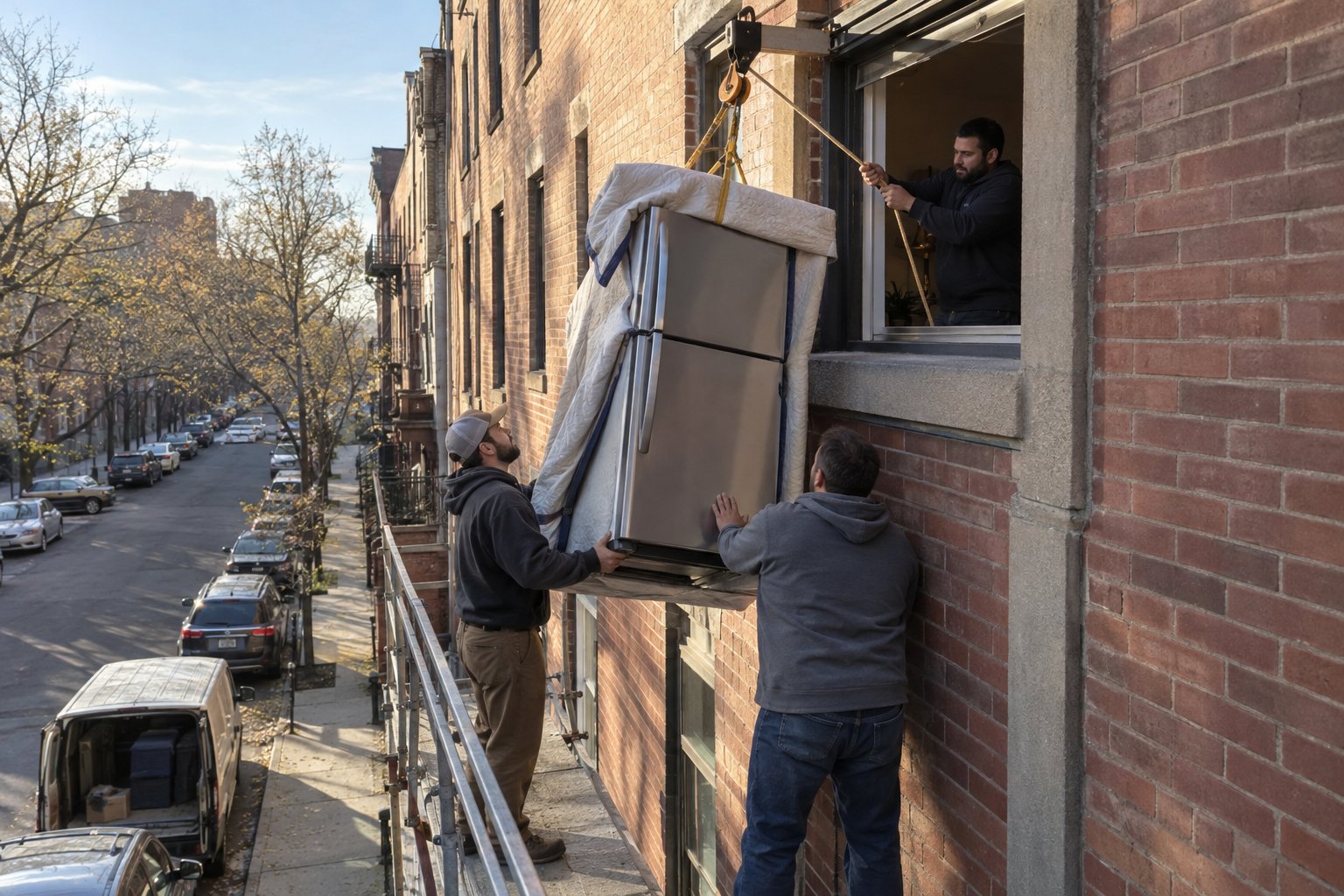
Appliance hoisting uses a mechanical lift, crane, or hoisting rig anchored to the building or a truck to raise the item to a window or balcony opening, bypassing the interior stairs entirely. The appliance is secured in a protective harness or crate, lifted along the exterior of the building, and guided through the opening by a crew stationed both outside and inside.
This is a different skill set than standard furniture moving. It requires rigging experience, an understanding of load limits and wind conditions, and often coordination with building management or the city if equipment will extend over a sidewalk or street. Not every moving company carries this equipment or the insurance to operate it, which is worth confirming before you assume "any mover" can solve a stairwell problem.
What the Crew Checks Before Hoisting Day
- Window or balcony opening size, and whether the sash or glass needs to be removed
- Overhead obstructions like power lines, tree limbs, or awnings along the lift path
- Ground clearance for outrigger stabilizers on a boom truck or crane
- Building management approval, since many condos and apartment buildings require advance notice for exterior lift work
- Weather, since high wind can postpone a hoist for safety reasons
What Does Hoisting an Appliance Cost Compared to a Standard Delivery?
Hoisting adds cost because it requires specialized equipment and a rigging-trained crew, on top of the standard moving labor. Expect the added expense to scale with the height of the lift, the weight of the appliance, and how much street or sidewalk access needs to be secured for the equipment. A ground-floor window hoist costs far less than a fourth-floor balcony lift requiring a crane and permits.
The way to avoid an unpleasant surprise is to get this assessed before the appliance arrives at your door, not after two movers are standing on your stoop realizing the fridge will not fit. If your new home has a known tight stairwell, narrow rowhome entry, or upper-floor unit with a small elevator, mention it when booking so the estimate reflects the equipment you will actually need.
Can You Avoid Hoisting by Just Removing Doors or Disassembling the Appliance?
Sometimes, but not as often as people hope. Removing a door frame's trim or taking a door off its hinges can add an inch or two of clearance, which occasionally makes the difference on a close call. Disassembly works well for furniture but is far more limited on appliances: a refrigerator's compressor and coils are not designed to come apart, and many warranties are voided if a technician other than an authorized service provider opens the sealed system.
Before assuming disassembly is an option, have your moving company measure the appliance's fixed dimensions (the parts that cannot be removed) against the true clearance of the path, diagonal included. If the fixed footprint still does not clear, hoisting stops being a fallback and becomes the plan.
Making the Call Before Moving Day
The best time to find out an appliance needs hoisting is during the estimate, not while it is stuck in a stairwell. Send photos or measurements of your tightest doorway, stairwell landing, and elevator cab when you book, and ask directly whether the appliance in question has ever caused problems in similar buildings. A moving company that offers dedicated hoisting services should be able to tell you within a few minutes of looking at the numbers whether you need it.
If you are moving heavy furniture as well as appliances, it is worth reading through general guidance on moving large and heavy furniture without damaging your home, since many of the same clearance issues apply to oversized couches, armoires, and pianos. And if your appliances are just one part of a larger household move that also needs packing help, our packing services team can coordinate both on the same day so you are not managing two separate crews.
Once you know hoisting is necessary, book it early. Rigging crews and lift equipment are scheduled separately from the moving truck, and a last-minute request on moving day itself is far harder to accommodate than one arranged a week or two in advance.
Frequently Asked Questions
How do you know if a refrigerator needs to be hoisted instead of carried up the stairs?
Measure the diagonal clearance of every doorway, stairwell landing, and hallway turn between the truck and the final location, then compare it to the refrigerator's width and depth. If the fixed dimensions do not clear even at an angle, or the stairwell has no landing space to pivot, hoisting through a window or balcony is usually the only safe option.
Will hoisting damage my windows or building exterior?
A trained rigging crew protects window frames and exterior surfaces with padding and works within the load and clearance limits of the opening. Damage risk comes mainly from using an inexperienced crew or skipping the pre-hoist inspection, which is why it is worth confirming your mover has dedicated hoisting equipment rather than improvising with standard moving gear.
Does homeowners or building insurance cover appliance hoisting?
Coverage varies by policy and building, so it is worth checking with your insurer and building management before hoisting day. Many condo and apartment buildings also require the moving company to carry its own liability coverage and provide proof before approving exterior lift work.
Can a moving company hoist an appliance through a balcony instead of a window?
Yes, balconies are a common hoisting point, especially in mid-rise and high-rise buildings where windows do not open wide enough. The crew will still need to check railing height, floor space on the balcony, and overhead clearance before confirming a balcony lift is workable.
Is hoisting only for refrigerators, or does it apply to other appliances too?
Hoisting applies to any appliance or large item that cannot pass through the interior path, which commonly includes washers, dryers, large ranges, and stacked laundry units in addition to refrigerators. The same diagonal measurement and clearance check applies regardless of which appliance is involved.

Have Questions About Your Move?
Find clear answers to common moving questions. Learn more about our services, process, and what to expect on moving day.
Our team is here to help. Contact us for personalized assistance with your moving needs.
Ready for a Stress-Free Move?
Let our family help your family with a move handled the right way from start to finish. Request your free quote today and see why Philadelphia families have trusted us since 1981.