
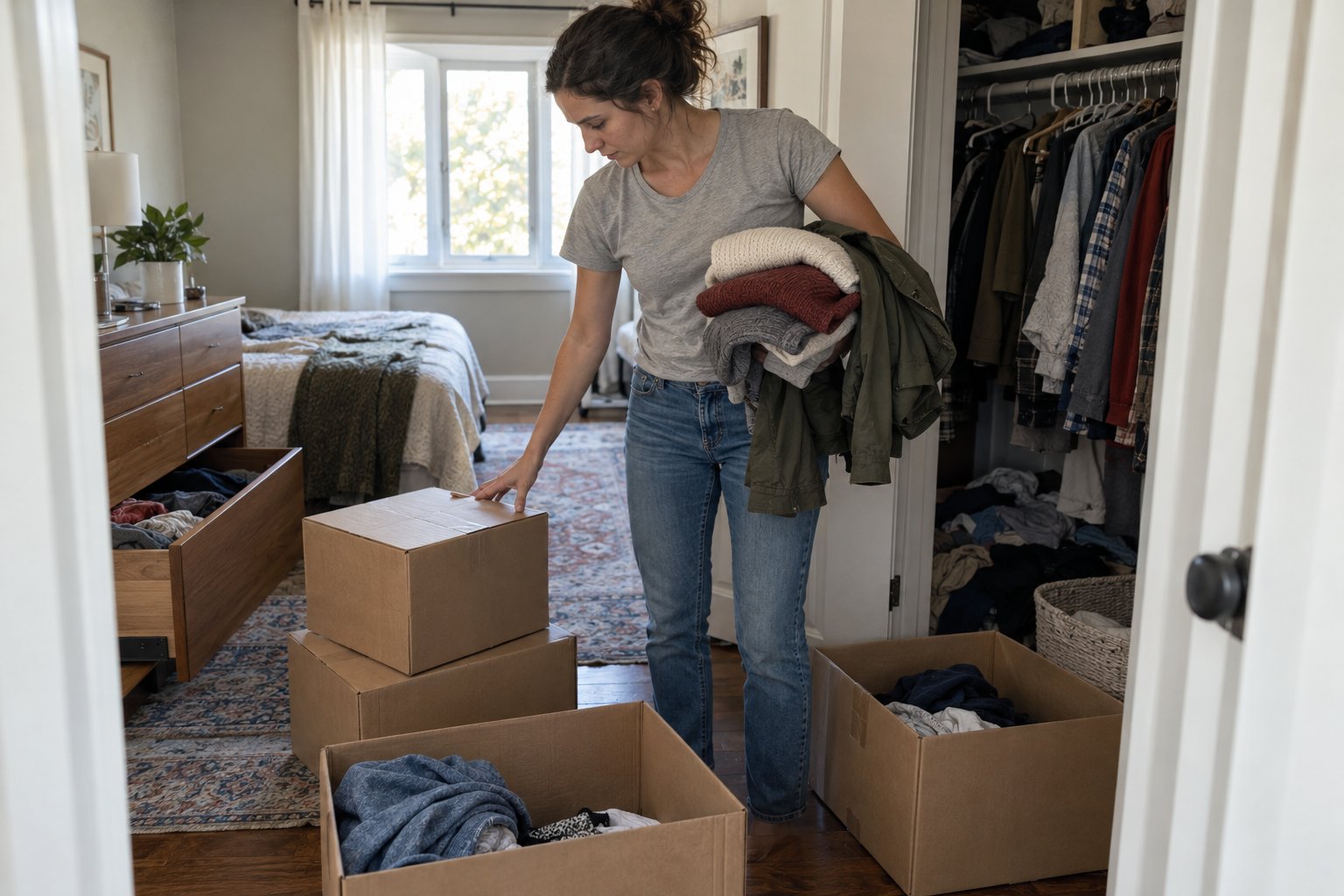
How Many Boxes Do You Need to Pack a House?
Written by:
Superior Moving & Storage
Published:
November 16, 2026
Wondering how many boxes you need for a move? Get a realistic room-by-room estimate plus the factors that change your box count.
A one-bedroom apartment typically takes somewhere around 20 to 30 boxes, a three-bedroom house closer to 60 to 90, and a larger home can easily climb past 100. Those numbers are a starting point, not a promise. The real count depends on how much you own, how you sort it, and what sizes of boxes you use.
Why Is There No Single Right Answer for Box Count?
There's no single right answer because two households of the same square footage can own wildly different amounts of stuff. A couple who has downsized for years will need far fewer boxes than a family who has lived in the same house for a decade and never cleared out a closet.
Instead of chasing an exact number, treat any estimate as a planning range. Buy a bit more than your estimate calls for, just to be safe. Running short mid-pack is more disruptive than having a few flattened extras left over.
How Many Boxes Per Room Should You Plan For?
Most rooms fall into a predictable range once you know what's actually in them. These are rough guides, not guarantees, since a home office stuffed with files packs differently than one with just a desk and a lamp.
- Kitchen: 15 to 20 boxes. Dishes, glassware, and small appliances take more boxes than their size suggests because fragile items need to go in loosely packed, well-cushioned boxes rather than crammed full.
- Living room: 8 to 12 boxes. Books, media, and décor add up quickly even though furniture itself usually doesn't get boxed.
- Bedroom: 10 to 15 boxes per room. Clothing, linens, and personal items dominate here, and wardrobe boxes can replace several standard boxes for hanging clothes.
- Bathroom: 3 to 5 boxes. Small but full of items that need to be grouped carefully so nothing leaks in transit.
- Home office: 5 to 10 boxes. Paper and files are heavier than they look, so smaller boxes work better here than large ones.
- Garage or basement: highly variable, often 15 or more. Tools, seasonal items, and anything stored "just in case" tend to hide here.
Add these ranges up room by room rather than relying on a whole-house average, since a two-bedroom home with a packed garage can need more boxes than a three-bedroom home with empty closets.
What Factors Change Your Box Count the Most?
The biggest swing factors are how long you've lived in the home, how much you declutter first, and what box sizes you choose. Each one can move your total by a meaningful margin in either direction.
Time in the home matters because belongings accumulate quietly. A household that hasn't moved in many years usually has more boxes to pack than the estimate suggests, simply because storage spaces fill up over time without anyone noticing. Clearing out items you no longer need before you start packing is one of the most effective ways to bring your count down; see our guide on decluttering before a move for how to approach that without it turning into its own project.
Box size also skews the math. Using all large boxes sounds efficient, but anything dense (books, tools, canned goods) gets too heavy to carry safely if packed in a big box. Experienced packers mix sizes deliberately: small and medium boxes for heavy items, larger boxes for lightweight, bulky ones like linens and pillows.
Standard Box Sizes and What They're Best Suited For
Picking the right size for the right item keeps boxes manageable and reduces how many you ultimately need, since the right box means less wasted space and fewer half-empty boxes.
- Small boxes: books, canned goods, tools, anything dense.
- Medium boxes: kitchen items, toys, small appliances, general catch-all items.
- Large boxes: linens, pillows, lampshades, lightweight bulky items.
- Wardrobe boxes: hanging clothing, which saves folding time and protects garments.
- Dish barrels or specialty boxes: fragile kitchenware that needs extra cushioning.
If you'd rather not estimate box sizes and quantities at all, our moving crate rental service uses stackable, reusable containers in a few standard sizes, which simplifies the "how many do I need" question considerably since crates are delivered in bulk and picked up after the move.
What's the Biggest Misconception About Counting Boxes?
The most common misconception is that square footage alone predicts box count. It doesn't. A 2,000 square foot home that's been lived in sparsely can need fewer boxes than a 1,200 square foot home packed with belongings in every closet and drawer.
Square footage tells you how much space you have to fill, not how much you've filled it with. A better predictor is simply walking through each room and estimating cabinet by cabinet, closet by closet, rather than applying a flat formula to the home's size.
Another related mistake is assuming the kitchen and living room will be the bulk of the job. In practice, garages, basements, and closets often produce more boxes than anyone expects, because those are the spaces where things get stored and forgotten rather than used and seen daily.
How Do You Get a More Accurate Estimate for Your Own Move?
The most accurate way to estimate is to walk through your home room by room with a notepad, counting cabinets, shelves, and drawers rather than guessing from memory. This takes maybe half an hour and produces a far more reliable number than any generic calculator.
If you'd rather skip the guesswork entirely, our packing services team can assess your home and bring the right mix of box sizes with them, which avoids both the shortage and the leftover-box problem altogether. If you're moving within the area and want packing help as part of a broader plan, our local moving company page covers how packing and moving day fit together. For a move that will involve both packing and settling into a new space, our guide to preparing your new home before moving day is a useful next step once your boxes are counted and packing is underway.
Whatever route you choose, plan on roughly a day to fully pack an average-sized room if you're doing it yourself, and build in buffer time for the rooms that always take longer than expected: the kitchen, the garage, and any closet you haven't opened in a while.
If you're relocating out of state and need to plan box counts around a tighter loading schedule, our long distance moving page covers how that timeline differs from a local move. And if your home is in King of Prussia, PA or elsewhere in New Jersey, a local walk-through with a mover ahead of time can shortcut the estimating process considerably.
For change-of-address planning once your boxes are packed and your move date is set, the USPS change of address service lets you forward mail starting on your move date, which is worth setting up a couple of weeks ahead so nothing gets lost in the shuffle.
Planning your move? Request a quote from Superior Moving & Storage.
Frequently Asked Questions
Do I need different box sizes for a move or can I just use one size?
Mixing sizes works much better than using one size throughout. Small boxes for dense items like books and tools keep weight manageable, while large boxes are better saved for bulky, lightweight things like linens and pillows. Using only large boxes for everything tends to produce boxes that are too heavy to carry safely.
How far in advance should I start collecting boxes before a move?
Most households start gathering boxes three to four weeks before moving day, since it takes time to collect the right mix of sizes and to pack non-essential rooms gradually instead of all at once. Starting early also gives you room to adjust your estimate as you go.
What should I tell a packing crew about my box needs before they arrive?
Let them know which rooms have the most to pack, including garages, basements, or closets that might not be obvious from a quick walkthrough, and point out anything fragile or unusually heavy. That lets the crew bring an appropriate mix of box sizes and packing materials instead of guessing on-site.
Can leftover moving boxes be reused or should they be recycled right away?
Flattened, undamaged boxes can often be reused for storage or a future move, so it's worth keeping a few rather than breaking all of them down for recycling immediately. For boxes that are too worn to reuse, recycling is the better option over sending them to the curb as trash.
Is it better to pack an entire room at once or spread it across several sessions?
Spreading a room across a few sessions is usually easier to manage than trying to finish it in one sitting, especially for rooms like the kitchen or garage that take longer than expected. Packing in shorter sessions also makes it easier to spot items you no longer need along the way.
Have Questions About Your Move?
Find clear answers to common moving questions. Learn more about our services, process, and what to expect on moving day.
Our team is here to help. Contact us for personalized assistance with your moving needs.
Ready for a Stress-Free Move?
Let our family help your family with a move handled the right way from start to finish. Request your free quote today and see why Philadelphia families have trusted us since 1981.